Chimney Cat
Games
Presents
TUNNEL STORY
MONSTER STORY
One Design Concept: Combining Combat, Wealth, Health, and Dice.
Monsters are the foundation of Tunnel Story. They create immediate danger in the moment, then become the resource that helps you survive what comes next.
Defeated monsters become Hostages: a resource for healing, dice, power and long-term strategy. By turning enemies into resources, Tunnel Story keeps combat fast, simple to read, and deep enough to carry the whole adventure.
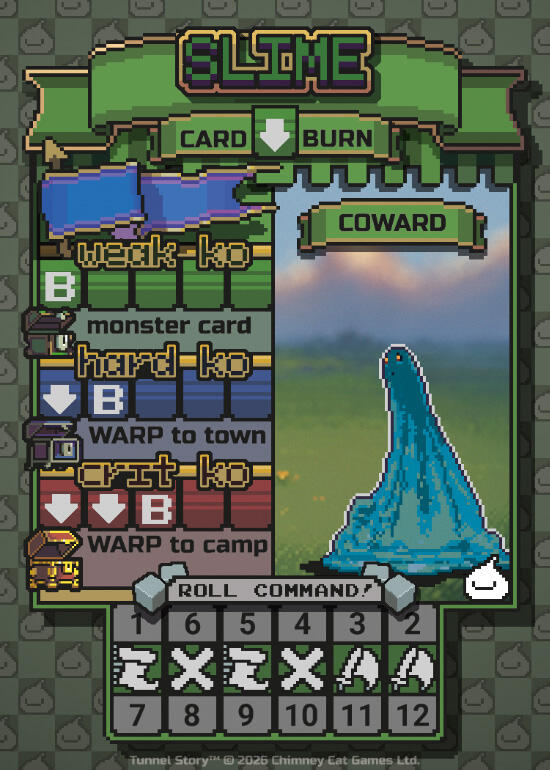
Let's check out the 7 Visible Parts of a Monster Card.
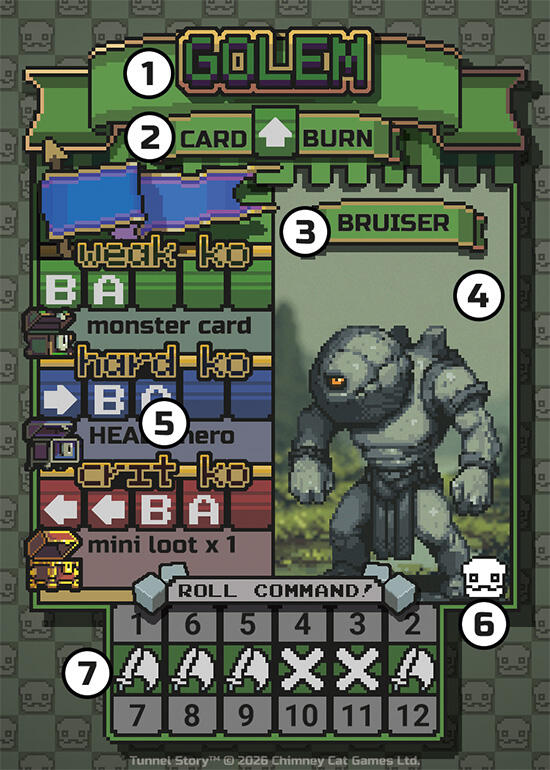
1. Monster Species (Top Middle)
2. Card Burn (Top Left)
3. Behavior Trait (Middle)
4. Monster Art (Middle Right)
5. K.O.M.B.O. Inputs (Middle Left)
6. Card Icon (Bottom Right)
7. Command Table (Bottom)
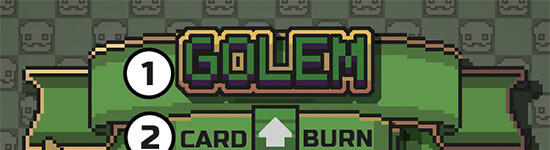
1. Monster Species (Top Middle) Species tells you what kind of creature you are facing. It shapes the monster’s identity, skills, and combat personality. Species tells you what it is. Tier tells you how dangerous that fight becomes. There are 6 monster species in Tunnel Story.
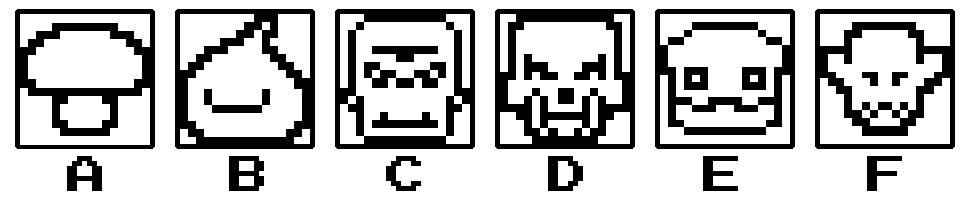
◾A) Shroom: Once a peaceful race, these spore-based creatures have become territorial masters of stealth. They spread effects, hazards, and lingering conditions. Hold your breath when dueling.
◾B) Slime: Unstable and hard to predict, no two Slimes feel quite the same. Some are cowardly, some are relentless, and some are more dangerous than a raging Golem.
◾C) Ogre: Massive threats that hit hard, punish mistakes, and apply heavy tolls. Brutish and violent, they swing enormous clubs carved from whole tree trunks.
◾D) Orc: Frontline aggression. Direct, dangerous fighters built around strength and momentum. Watch out for the Chieftains. They can call in reinforcements and turn one bad fight into many.
◾E) Golem: Heavy, durable creatures that stand as protectors of the Drift. They control space through force and resilience. Not cruel like Orcs or Goblins, but they will strike without hesitation to defend what they guard.
◾F) Goblin: Fast, opportunistic enemies that steal, disrupt, and rely on dirty tactics. Check your backpack after a duel. Something is always missing.
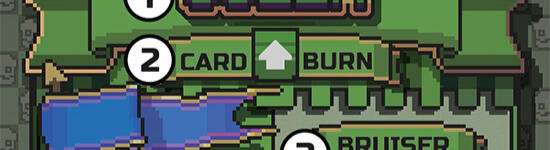
2. Monster Card Burn (Top Left) If you have captured monster, you may Burn it from your hand during a future Duel. When burned, that monster grants its exact directional symbol directly into your active dice pool.
Single Use. Recycle. A captured Monster is an economic choice with four possible uses: Burn it during a Duel for a guaranteed directional symbol. Spend it to block an incoming hit. Trade it at Camp or Town for resources. Cash it in toward a Hero's Level Recipe.
Tunnel Story gives you options, and the right choice depends on the moment.
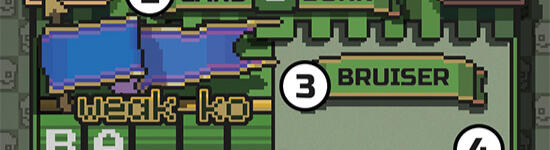
3. Behavior Trait (Middle) If Species tells you what the monster is, Behavior tells you how it fights. Behavior shapes combat style, battlefield tension, and the kind of trouble the monster brings.
◾Coward: Avoids direct fights and wastes time through fleeing, delaying, or stalling. Favors the Flee icon and turns every Duel into a chase.
◾Ambusher: Strikes first and punishes second. These monsters steal the player’s usual first move and keep the party on the back foot.
◾Bruiser: Applies direct force and tests raw combat strength. Swing after swing, they overwhelm the Duel through simple, brutal attacking.
◾Chieftain: Empowers the battlefield and escalates pressure if left alive. Chieftains call in reinforcements, clog the board, and cause players many headaches.
◾Shaman: Disrupts systems through curses, summons, and interference. They twist the rules of the fight, reshuffle your plans, and warp the party into far-off positions..
◾Thief: Steals resources, hits hard, and runs if not stopped. They steal, flee, and chip away at your hand until you have nothing useful left.
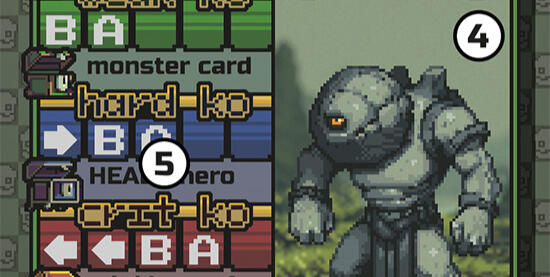
4. Card Profile (Middle Right) The visual portrait of the monster you are engaging.
5. K.O.M.B.O. Inputs (Middle Left) The K.O.M.B.O. section is the recipe for how to defeat that monster. To win the Duel, you must match the exact inputs shown for the KO tier. Weak, Hard, or Crit. You dont have to choose or call out the tier, just roll and plan for inputs you need.
As the K.O. grows in inputs, it becomes harder to complete. Weak teaches how to fight, Hard increases rewards, and Crit demands precision with a bit of luck. Higher tiers increase K.O. complexity, not randomness.
Reward Stacking: Rewards are cumulative. Defeating a Monster at Crit earns all three tier rewards. Defeating at Hard earns Hard and Weak rewards. Defeating at Weak earns Weak only.
Special Example: The Loot Goblin
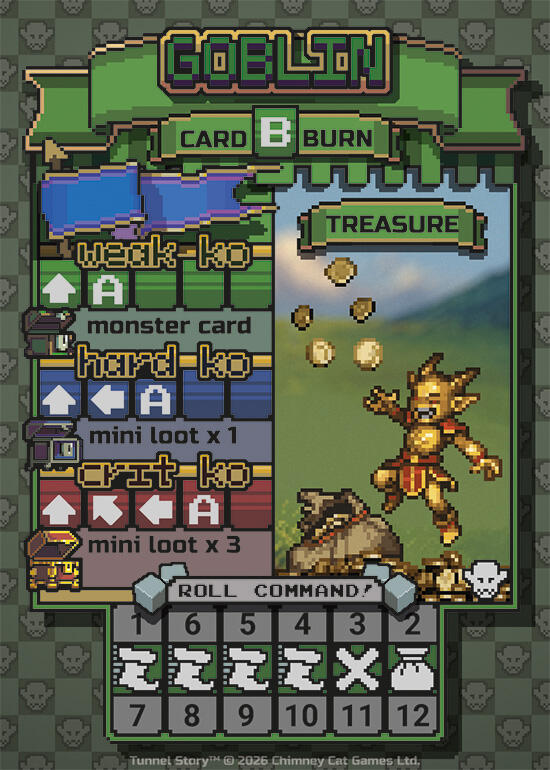
◾ Monster and Terrain cards can borrow from each other, creating some interesting card builds.
◾ The Loot Goblin uses Treasure behavior, borrowing from Terrain logic.
◾ If you roll 2d6 = 2 or 12, you gain 1 free Mini Loot card per Duel.
◾ Defeat the Loot Goblin on Crit K.O. and the payout becomes massive because the rewards stack upward.
Full Terrain behavior rules are covered in the Terrain Page. The Loot Goblin example is shown here to illustrate that some Monster cards borrow mechanics from other game elements.
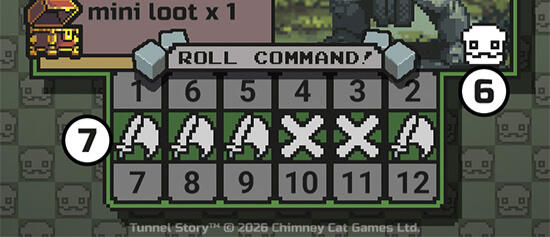
6. Card Icon (Bottom Right): The reference icon of this card. Used for fast recognition in card layout, effects, and future cross-system reference.
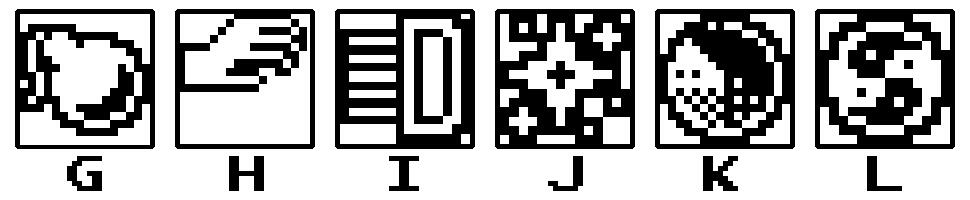
7. Command Table (Bottom): The Monster system uses 12 command icons. Each standard Monster card displays 6 of those icons, one in each grouped 2d6 result slot. If you fail to defeat the monster, you face the consequences. Roll 2d6, find the matching result group on the monster's Command Table, and resolve that icon. The card tells you exactly what you gotta deal with!
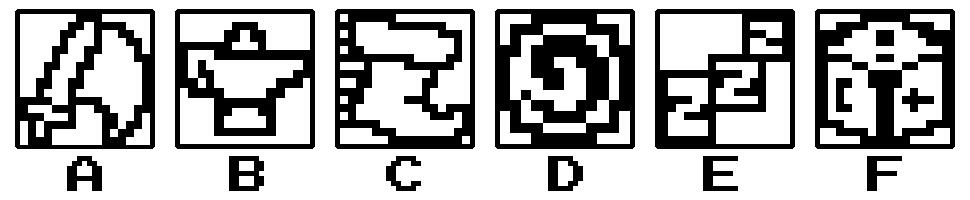
◾A) Attack: Deal 1 damage to a Hero in your party. You choose which Hero receives the hit.
◾B) Summon: A Monster of the current tier is spawned on the overworld, as far from the active player as possible following the Greed Rule.
This Monster is in play on the board but is not part of the current Duel.
◾C) Flee: The monster escapes and the Duel ends. The monster is removed from play and recycled.
◾D) Warp: Your party is moved to the Tunnel card of your current tier, or to Town if no Tunnel is in play. The Duel ends in a draw. The monster is removed from play and recycled.
◾E) Sleep: The player loses their next Duel turn and the monster strikes again. Roll 2d6 immediately on the Command Table and resolve the new result. Sleep can only trigger once per Duel. If rolled again, treat it as Miss.
◾F) Curse: The player loses 1 Pixel d6. That die is placed at Town and cannot be used until the player visits Town to recover it. A player may only lose a maximum of 1 die this way. If rolled again on an already Cursed player, treat as Miss.
◾G) Explode: All Heroes on this Terrain card take 1 damage, including other players' Heroes if present. The monster is then removed from play and recycled.
◾H) Steal: Lose 1 card from your hand. The stolen card is recycled. Triggers once per Duel. If rolled again, treat it as Miss.
◾I) Disrupt: Shuffle 1 deck chosen by the player to your right. In solo play, choose 1 deck yourself. Options: Terrain, Monster, or Mini Loot.
Shuffling a deck removes any predictability players have built through earlier draws or knowledge of what remains and changing what comes next.
◾J) Hex: Disable Hero skills for 1 Duel turn. The tier of the Monster determines which skills are lost: Weak tier = Hero loses Skill 1 only.
Hard tier = Hero loses Skills 1 and 2.
Crit tier = Hero loses Skills 1, 2, and 3.
◾K) Shroud: Other players cannot assist the engaged player for this Duel turn. Return to normal after monster's roll.
◾L) Counter: Relic and Hero(party) Skill Bonuses are disabled for the rest of the Duel.
THE DUEL: Your Party vs. Monster
When you roll or step onto a monster, a Duel begins. In Tunnel Story, the player strikes first. The monster only acts if you fail to complete its K.O. Inputs.
Exception: Ambusher monsters roll the Command Table result before the player's first roll. It gets to attack the player first.
Combat follows a natural sequence, but burning Loot, Hostage cards, and using Hero Skills are instant actions available at any point. This can happen even before your first roll.
Strike -> Free Reroll -> Matching Sets -> Optional Loot -> Optional Burn Card -> Monster Turn -> Command Table -> Resolve Icon1. Strike & Bank: Roll your active dice pool. Bank any exact matches against the monster’s K.O.2. Free Reroll (Second Swing): You receive exactly 1 free unconditional reroll of all unbanked dice.
You receive one free reroll at the start of each Duel round. If the Monster acts and a new round begins, your free reroll resets.3. Matching Sets: If your combo is still incomplete, look at your remaining unbanked dice. If two or more dice show the same face, that is a Matching Set. Remove all dice in that set from your pool and immediately roll that many new Controller Dice. Two matching dice: roll 2 new dice. Three matching: roll 3. Repeat this process until no matching sets remain. Bank any new matches each time.
Color Dice can count toward a Matching Set, but removing one costs you its wildcard value. Use with caution.4. Last Push (Loot and Burn): Out of matching sets? Burn Loot and/or Hostages from your hand to bank exact missing symbols. This action can be done any time in the Duel, even before you roll the dice.For example, if you know you need an UP input and you hold a Golem Hostage, you can burn it before rolling to secure UP immediately and roll for the remaining inputs.5. K.O. vs. Monster Turn: If the combo is complete, the monster is defeated. If not, you face the consequences — roll 2d6 on the Command Table (or 1d6 if you are Cursed, having lost 1 die from your pool) and resolve the icon shown.6. Captured Monster Help: Before a Hero takes the hit, you may choose to discard a captured Hostage of equal or higher tier. That Hostage absorbs the damage completely and is recycled. If you have no valid Hostage or choose not to spend one, assign the damage to a Hero.
Monsters Tier System is divided into three tiers.
🟢 Weak monsters introduce core behaviors and forgiving outcomes.
🔵 Hard monsters increase damage, add layered effects, and punish mistakes quickly.
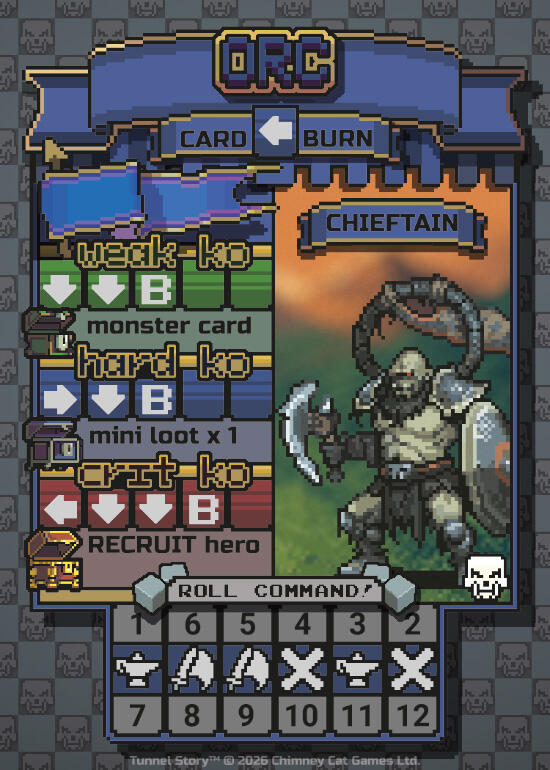
🔴 Crit monsters apply maximum tension, minimal recovery, and restrict your options.
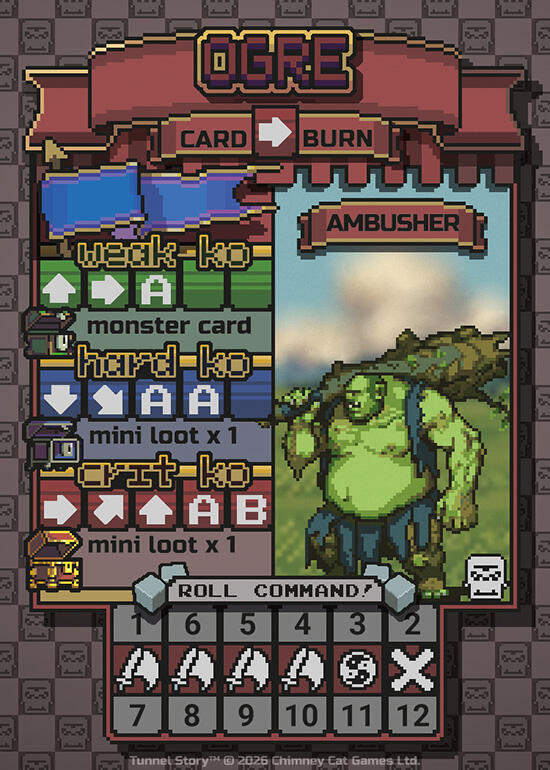
The deeper you explore, the harder the world becomes.Weak teaches the basics, Hard tests the system, and Crit pushes the party to the limits.Every Tunnel you reveal is a choice: push forward and face it, or delay and let the monsters surround around your party.
Coming in May: All things Relics and then Heroes.
Have a great early summer,
Chimney Cat team
(Note: All cards/rules are subject to change before final release)
If you missed our campaign, don't dismay! Just click the cart.
© 2026 Chimney Cat Games Ltd. All rights reserved.